
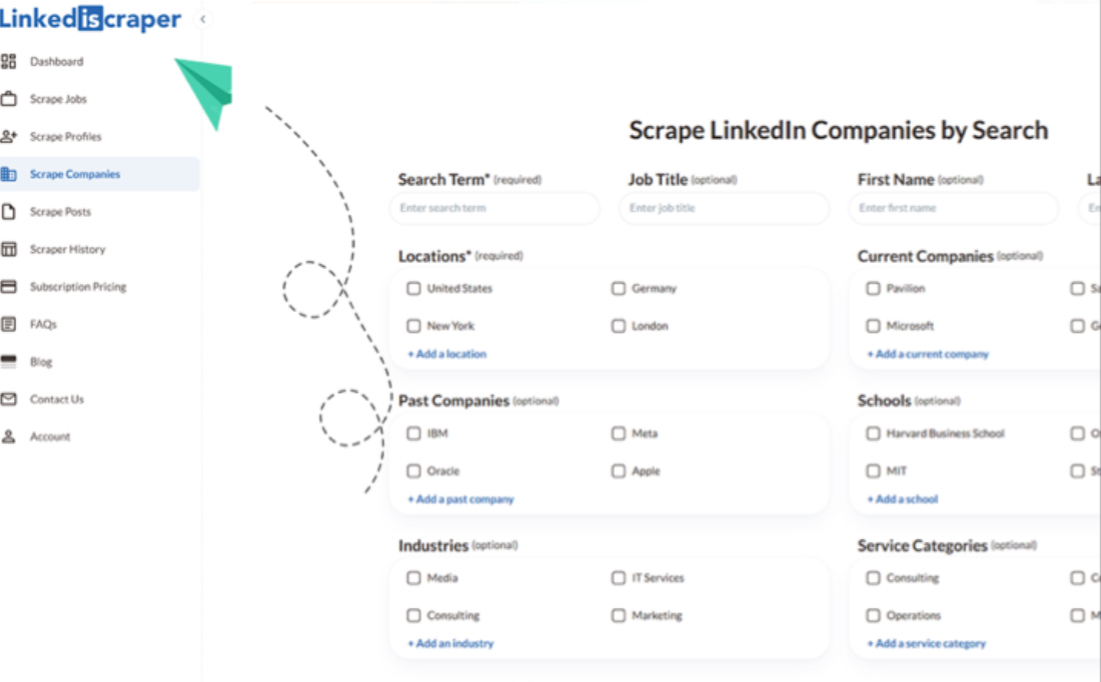
Are you struggling to find the right contacts and leads on LinkedIn quickly? Imagine having a tool that can gather important information from LinkedIn profiles effortlessly, saving you hours of manual work.
That’s exactly what a LinkedIn scraper can do for you. Whether you’re building a sales pipeline, recruiting top talent, or growing your network, this tool can give you the edge you need. Keep reading to discover how a LinkedIn scraper works and how it can transform your approach to networking and outreach.
What Is A linkediscraper
linkediscraper is a tool designed for automated data collection from LinkedIn profiles. It helps gather useful information quickly by using web scraping techniques. This process involves profile mining, where the scraper extracts details such as job titles, skills, and education. It also performs contact information retrieval and email harvesting to collect emails and phone numbers from public profiles. Social media scrapinglike this, saves time compared to manual data entry.
Many scrapers use data parsing to organize the collected information into readable formats. Some tools offer API integration to connect the scraper with other software for lead generation or marketing. Platforms like linkediscraper. provide easy access to these features, helping businesses grow by data extraction from LinkedIn profiles.
What Does A LinkedIn Scraper Do?
A LinkedIn scraper collects data from profiles, such as:
- Name and job title
- Company and industry
- Skills and endorsements
- Contact details like emails and phone numbers
The tool automates these tasks, allowing users to gather large amounts of data fast. It reduces manual work and improves accuracy.
How Does Profile Mining Work?
Profile mining scans public LinkedIn profiles to extract relevant data. It uses data parsing to separate information into fields like name, job, and email. The process includes:
- Accessing profile pages
- Extracting visible data
- Cleaning and organizing data
- Saving data for further use
Benefits Of Using A LinkedIn Scraper
| Benefit | Description |
| Time-saving | Collects data faster than manual searching |
| Accuracy | Reduces errors in data collection |
| Lead Generation | Finds potential customers with contact info |
| Scalability | Handles large volumes of profiles easily |
Common Features Of LinkedIn Scrapers
- Automated data extraction from profiles
- Support for email harvesting and contact retrieval
- Integration with other tools using API integration
- Export data in CSV or Excel formats
- Filters to target specific industries or roles
Key Features Of LinkedIn Scrapers
LinkedIn scrapers are tools designed to collect information from LinkedIn profiles and pages efficiently. These tools help gather data such as names, job titles, companies, contact details, and more. Key features of LinkedIn scrapers determine how well they perform and how useful they are for businesses, recruiters, and marketers. Understanding these features helps choose the right scraper to meet specific needs.
Data Extraction Capabilities
LinkedIn scrapers focus on collecting various types of data quickly and accurately. The ability to extract detailed and relevant information is crucial. Most scrapers can collect data such as:
- Profile details: Name, job title, company, location
- Contact information: Email addresses, phone numbers (if available)
- Skills and endorsements: Key skills listed on profiles
- Education: Schools, degrees, and certifications
- Experience: Previous jobs and roles
Some advanced scrapers offer filters to narrow down data by industry, location, or job title. This filtering saves time and increases relevance.
| Feature | Description | Benefit |
| Bulk Data Extraction | Scrape data from many profiles at once | Save time by collecting large datasets quickly |
| Custom Field Selection | Choose specific data points to extract | Get only the information you need |
| Data Export Formats | Export data in CSV, Excel, or JSON | Easily use data in other applications |
Accurate data extraction avoids errors and duplicates. This improves the quality of the collected data, making it more useful for outreach or analysis.
Automation And Scheduling
Automation helps run scraping tasks without manual effort. Scheduling allows these tasks to happen at set times or intervals. These features make LinkedIn scrapers more efficient and reliable.
Common automation and scheduling features include:
- Automatic scraping: Set the scraper to run at specific times, such as daily or weekly
- Task queuing: Manage multiple scraping tasks in order
- Pause and resume: Stop a task and continue later without losing progress
- Alerts and notifications: Get notified when a task completes or if an error occurs
These options reduce manual work and ensure data stays fresh. For example, recruiters can update their lead lists automatically every week.
| Automation Feature | Purpose | Benefit |
| Scheduled Runs | Run scraping tasks at set times | Keep data updated without manual input |
| Batch Processing | Handle multiple requests in one go | Increase efficiency and save time |
| Error Handling | Detect and fix scraping issues automatically | Ensure smoother operation and less downtime |
Automation also helps avoid LinkedIn limits by spreading requests over time. This reduces the chance of account restrictions.
Integration Options
Integrating LinkedIn scrapers with other tools improves workflow and data use. Many scrapers offer connections to popular software and platforms.
Typical integration options include:
- CRM systems: Automatically add scraped leads to Salesforce, HubSpot, or Zoho
- Email marketing tools: Export contacts directly to Mailchimp or Sendinblue
- Data analysis software: Connect with Google Sheets or Excel for easy review
- APIs: Access scraper functions programmatically for custom solutions
These integrations save time by eliminating manual data transfer steps. They also help keep all tools up to date with the latest information.
| Integration Type | Example Tools | Use Case |
| CRM | Salesforce, HubSpot, Zoho | Manage and track leads efficiently |
| Email Marketing | Mailchimp, Sendinblue | Send campaigns to targeted contacts |
| Data Analysis | Google Sheets, Excel | Analyze and organize scraped data |
| API | Custom software | Build tailored scraping workflows |
Flexible integration options make LinkedIn scrapers suitable for many business needs. They help connect data collection with marketing, sales, and analytics tools smoothly.
Popular LinkedIn Scraper Tools
LinkedIn Scraper tools help gather data from LinkedIn profiles quickly and efficiently. These tools collect information like names, job titles, emails, and companies. Many professionals use them to build lists, find leads, or do market research. Popular LinkedIn Scraper tools come in different types based on how they work and what features they offer. Each type fits different needs and skill levels.
Standalone Software
Standalone LinkedIn Scraper software is a program installed on a computer. It runs independently without needing a browser. These tools often have rich features for deep data extraction and management. Users can save scraped data in various formats, like CSV or Excel.
Key benefits of standalone software include:
- High data control – Users can customize scraping settings.
- Fast processing – Runs on local machines, reducing delays.
- Data privacy – No need to share data with third-party servers.
Examples of popular standalone tools:
| Tool Name | Main Features | Use Case |
| LinkedIn Helper | Automated connection requests, message campaigns | Lead generation |
| PhantomBuster | Data extraction, workflow automation | Marketing and sales |
| Octoparse | Visual scraping, no coding needed | Data collection for research |
Standalone tools often require some setup but offer powerful options. They suit users who want detailed control over data scraping.
Browser Extensions
Browser extensions are add-ons installed in web browsers like Chrome or Firefox. They work directly on LinkedIn web pages, scraping visible profile data. These tools are easy to use and do not need software installation.
Advantages of browser extensions include:
- Quick setup – Install and use instantly.
- On-the-go scraping – Extract data while browsing LinkedIn.
- User-friendly interfaces – Simple controls inside the browser.
Popular browser extension tools:
- DataMiner – Extracts data from tables and lists on LinkedIn.
- LeadLeaper – Gathers emails and profile details.
- Scraper – Allows custom XPath scraping.
Browser extensions fit casual users or those who need quick data access. They have limits on how much data they can scrape at once.
Api-based Solutions
API-based LinkedIn scrapers connect directly to LinkedIn’s data through programming interfaces. These solutions allow automated, large-scale data extraction. Developers can build custom apps or integrate scraping into existing tools.
- Benefits of API-based tools:
- Automation – Schedule data retrieval without manual work.
- Scalability – Handle large volumes of data smoothly.
- Customization – Tailor data fields and formats as needed.
Common API-based solutions include:
| Service | Features | Ideal For |
| PhantomBuster API | Automated LinkedIn workflows, data export | Developers and businesses |
| TexAu | Multi-platform automation, LinkedIn data scraping | Marketing teams |
| SerpApi | LinkedIn search data extraction | Data analysts |
API tools require programming knowledge but offer flexibility and power. They suit organizations needing continuous, large data streams.
Legal And Ethical Considerations
Using a LinkedIn scraper can help collect useful data from LinkedIn profiles. But it also raises important legal and ethical questions. Understanding these concerns protects users and respects others’ rights. It is key to use scraping tools carefully and responsibly. This section covers the main issues to consider before scraping LinkedIn data.
LinkedIn’s Terms Of Service
LinkedIn’s Terms of Service (ToS) clearly state rules about data use and scraping. The platform strictly forbids unauthorized collection of information. Violating these terms can lead to account suspension or legal action.
Key points from LinkedIn’s ToS include:
- No automated scraping: LinkedIn blocks tools that collect data automatically.
- Use data only for intended purposes: Data must not be used to spam or harass users.
- Respect intellectual property: LinkedIn owns the rights to the data on its platform.
Below is a summary table of some important LinkedIn ToS sections related to scraping:
| Section | Rule | Impact |
| Automated Data Collection | Prohibited without permission | Account suspension or legal action |
| User Data | Use only for personal, non-commercial purposes | Restriction on data usage |
| Content Ownership | LinkedIn owns platform content | No unauthorized reproduction |
Following these rules helps maintain trust and avoid penalties. It also supports fair use of LinkedIn’s services.
Data Privacy Concerns
Data privacy is a major concern when scraping LinkedIn profiles. Personal data must be handled carefully to protect individual privacy rights. Misusing data can cause harm and legal trouble.
Important privacy issues include:
- Personal information: Names, emails, phone numbers, and job details are sensitive.
- Consent: Users must agree to share their data, especially for marketing or sales.
- Data storage: Secure methods are needed to protect collected data from breaches.
- Compliance: Laws like GDPR and CCPA regulate data collection and usage.
Failing to respect privacy can lead to:
- Legal fines and penalties
- Damage to reputation
- Loss of user trust
Always ask whether data collection respects privacy rights. Use data only for clear, lawful purposes. Keep data safe and limit access.
Best Practices
Following best practices reduces risks and improves ethical use of LinkedIn scraping tools. Responsible behavior protects users and your own interests.
Recommended best practices include:
- Review LinkedIn policies: Stay updated on terms and legal changes.
- Limit data collection: Gather only necessary information.
- Obtain consent: Get permission before using personal data for outreach.
- Use data ethically: Avoid spamming or misleading people.
- Secure data: Encrypt and store information safely.
- Monitor usage: Regularly check that data is used properly.
Here is a simple checklist for ethical LinkedIn scraping:
| Task | Action | Status |
| Understand ToS | Read and comply with LinkedIn’s Terms | ✔ |
| Data Minimization | Collect only the needed data | ✔ |
| Consent | Request permission from users | ✔ |
| Security | Encrypt and protect data | ✔ |
| Ethical Use | Avoid spam and misuse | ✔ |
Applying these rules creates trust and keeps your LinkedIn scraping lawful and ethical.
Use Cases For LinkedIn Scrapers
LinkedIn scrapers collect data from LinkedIn profiles and pages automatically. This data helps businesses and professionals save time and find useful information quickly. Many industries use LinkedIn scrapers to get contact details, job histories, company info, and more. The tools work best for tasks that need large amounts of data from LinkedIn. Below are the main use cases for LinkedIn scrapers.
Recruitment And Hiring
Recruiters use LinkedIn scrapers to find candidates faster and more efficiently. Instead of searching profiles one by one, scrapers gather many profiles in a short time. This helps recruiters build a large list of potential candidates who match job requirements.
Key benefits in recruitment include:
- Automated candidate sourcing: Collect profiles with specific skills and experience.
- Contact information extraction: Get emails and phone numbers for outreach.
- Resume and work history analysis: Compare candidates based on job titles and durations.
- Talent pool creation: Build a database for future hiring needs.
The table below shows how LinkedIn scrapers improve recruitment:
| Recruitment Task | Without Scraper | With LinkedIn Scraper |
| Candidate Search | Manual, slow | Automated, fast |
| Contact Info Collection | Time-consuming | Extracted quickly |
| Resume Comparison | Manual reading | Data organized and filtered |
LinkedIn scrapers help recruiters focus on talking to candidates rather than searching for them.
Sales And Lead Generation
Sales teams use LinkedIn scrapers to find new leads and grow their client base. The tool collects data about potential customers and companies, making it easier to reach out with personalized messages.
Benefits for sales include:
- Lead identification: Find decision-makers and relevant contacts.
- Company insights: Learn about company size, industry, and location.
- Contact detail extraction: Get emails and phone numbers for direct outreach.
- Targeted campaigns: Build lists segmented by job title or sector.
Example of lead generation process using LinkedIn scraper:
- Define target audience (e.g., marketing managers in tech companies).
- Run scraper to collect profiles matching criteria.
- Extract contact details and company info.
- Import data into CRM for outreach.
LinkedIn scrapers reduce the time needed to create accurate lead lists. Sales teams spend more time closing deals instead of searching for contacts.
Market Research
Market researchers use LinkedIn scrapers to gather data about industries, competitors, and trends. The scraper collects public information to analyze business landscapes and customer needs.
Ways LinkedIn scrapers support market research:
- Industry analysis: Collect data on companies in specific sectors.
- Competitor tracking: Monitor company growth and employee changes.
- Trend spotting: Identify popular skills and job titles over time.
- Customer profiling: Understand potential customer demographics and preferences.
Here is a summary table of market research uses:
| Research Aspect | Data Collected | Purpose |
| Industry Data | Company size, sector, location | Market segmentation |
| Competitor Info | Employee count, new hires | Competitive analysis |
| Skill Trends | Popular job skills and roles | Talent demand insights |
Using LinkedIn scrapers, researchers collect large data sets quickly. This helps them make informed decisions based on real market information.
How To Choose The Right Scraper
Choosing the right LinkedIn scraper is crucial for efficient and effective data gathering. The right tool saves time, reduces errors, and fits your business needs. Many scrapers offer different features, so understanding key factors helps select the best one. Focus on scalability, ease of use, cost, and support to find a solution that grows with your demands and stays user-friendly.
Scalability
Scalability means the scraper can handle more data and users as your needs grow. A scalable LinkedIn scraper adjusts without losing speed or accuracy.
Consider these points:
- Data Volume: Can the scraper collect thousands or millions of profiles?
- Concurrent Tasks: Does it support multiple scraping jobs at once?
- Performance: Will it maintain speed with large datasets?
- Cloud vs Local: Cloud-based scrapers often scale more easily than local software.
Here is a simple comparison table for scalability features:
| Feature | Low Scalability | High Scalability |
| Max Profiles per Run | Up to 1,000 | 100,000+ |
| Simultaneous Tasks | 1-2 | 10+ |
| Speed | Slow to Moderate | Fast and Consistent |
Choose a scraper that fits your current needs but can expand without extra costs or technical issues.
Ease Of Use
A LinkedIn scraper should be simple to set up and operate. Complex tools waste time and cause frustration.
Look for these qualities:
- User Interface: Clean, clear layout with easy navigation.
- Setup Process: A Few steps to start scraping.
- Automation: Ability to schedule scraping tasks automatically.
- Documentation: Helpful guides and tutorials available.
Here is a checklist for ease of use:
- Can you start scraping within 10 minutes?
- Is the dashboard intuitive?
- Does it offer templates or presets?
- Are error messages clear and helpful?
- Is customer support responsive to usability questions?
Testing a demo or trial version helps confirm ease of use. A good scraper works smoothly for beginners and experts alike.
Cost And Support
Cost is a major factor, but not the only one. Balance price with features and support quality.
Check these details:
- Pricing Models: Monthly subscription, one-time payment, or pay-as-you-go?
- Hidden Fees: Extra charges for more data or users?
- Support Options: Email, chat, phone, or community forums?
- Response Time: How fast does support reply?
- Updates: Frequency of software updates and bug fixes.
Use the table below to compare cost and support features:
| Aspect | Basic Plan | Premium Plan |
| Price | $20/month | $100/month |
| Data Limit | 5,000 profiles | 50,000 profiles |
| Support | Email only | Email + Chat + Phone |
| Update Frequency | Quarterly | Monthly |
Choose a plan that fits your budget and offers reliable support. Good support prevents downtime and helps solve issues fast.
Step-by-step Scraping Process
The LinkedIn Scraper is a powerful tool that helps gather data from LinkedIn profiles quickly. Understanding the step-by-step scraping process is essential to using this tool effectively. This process includes setting up the tool, configuring the search parameters, and exporting the data for use. Each step ensures you collect accurate and useful information while saving time.
Setting Up The Tool
Start by installing the LinkedIn Scraper software or browser extension. Most tools require a simple download and installation process. After installation, log in with your LinkedIn account to allow the scraper to access profile data.
Follow these steps to set up the tool:
- Download the scraper from a trusted source.
- Install it on your computer or browser.
- Log in to your LinkedIn account through the tool interface.
- Verify your account with any security steps if needed.
Setting up properly ensures the tool runs smoothly and respects LinkedIn’s usage policies. Many tools also offer a demo mode to practice scraping without affecting your account.
| Step | Action | Purpose |
| 1 | Download and install | Set up the scraper on your device |
| 2 | Log in | Connect your LinkedIn account |
| 3 | Verify account | Ensure security and access |
Note: Keep your login credentials safe and never share them with third parties.
Configuring Search Parameters
Configuring search parameters helps target the right profiles. You can filter by job title, location, industry, company, and more. Precise filters improve the quality of the scraped data.
Common search parameters include:
- Keywords: Specific skills or roles.
- Location: City, state, or country.
- Industry: Technology, finance, healthcare, etc.
- Company: Target specific organizations.
- Experience level: Entry, mid, senior.
Set these filters in the tool’s interface before starting the scraping process. Here is a simple example of configuration:
| Parameter | Example Value |
| Job Title | Marketing Manager |
| Location | New York, USA |
| Industry | Advertising |
| Experience Level | Mid-Level |
Use clear and specific terms for better results. Avoid overly broad searches to reduce irrelevant data. Some tools allow saving search presets to reuse later.
Exporting And Using Data
After scraping, export the data into a usable format. Most LinkedIn scrapers support CSV, Excel, or JSON files. Exporting allows easy data handling for marketing, sales, or research.
Steps to export and use data:
- Complete scraping: Wait for the tool to finish collecting profiles.
- Choose export format: Select CSV or Excel based on your needs.
- Download file: Save the file to your device.
- Open and review: Check data accuracy and completeness.
- Use data: Import into CRM, email tools, or databases.
Here is an example of common export formats and their uses:
| Export Format | Best For |
| CSV | Simple data lists, spreadsheet analysis |
| Excel | Advanced data sorting, filtering, and charts |
| JSON | Data integration with software or web apps |
Important: Respect LinkedIn’s terms and privacy laws when using scraped data. Use the data ethically to build connections or insights.
Avoiding Common Scraping Pitfalls
Using a LinkedIn scraper can save time and gather important data fast. But scraping comes with risks and problems that can stop your work. Avoiding common scraping pitfalls helps keep your project smooth and safe. Knowing these issues lets you prepare better and get good results.
Account Suspension Risks
LinkedIn has strict rules to protect user data. Scraping too much or too fast can trigger these rules. Your account may get suspended or banned. This stops you from accessing LinkedIn completely. The risk is high if you scrape without limits or use fake accounts.
Ways to reduce suspension risks:
- Limit the number of requests per hour
- Use official LinkedIn APIs when possible
- Avoid using multiple accounts from the same IP
- Respect LinkedIn’s terms of service
Here is a simple table showing safe scraping limits:
| Scraping Action | Recommended Limit |
| Profile Views | Less than 50 per hour |
| Search Queries | Less than 30 per hour |
| Data Downloads | Under 1000 entries per day |
Stick to these limits to keep your account safe. Use delays and random intervals between requests. This mimics human behavior and lowers detection chances.
Data Accuracy Issues
Scraped data is only useful if it is accurate. LinkedIn profiles change often. People update jobs, skills, and contact info regularly. Scrapers may collect outdated or wrong details. This can lead to bad decisions or lost opportunities.
Common causes of data errors:
- Incomplete profile information
- Data blocked by LinkedIn privacy settings
- Page format changes are breaking scraper logic
- Duplicated or merged profiles
To improve data accuracy, try these tips:
- Verify data by checking multiple sources
- Update your scraped data regularly
- Use advanced parsers that adapt to layout changes
- Filter out incomplete or suspicious entries
Example of a verification checklist:
| Checkpoint | Action |
| Name Consistency | Match with other social profiles |
| Job Title | Confirm with the company websites |
| Contact Info | Validate email or phone through tests |
Keep data clean and verified for best results. Avoid relying on old or incomplete data sets.
Technical Challenges
Scraping LinkedIn is not easy. The site uses complex code and security checks. These can block or confuse scrapers. Handling technical challenges is key to success.
Main technical issues include:
- Dynamic page content loaded by JavaScript
- Use of CAPTCHA and bot detection systems
- Frequent changes in HTML structure
- Rate limiting and IP blocking
Effective ways to solve technical problems:
- Use headless browsers to render JavaScript content
- Incorporate CAPTCHA-solving services or manual input
- Monitor LinkedIn page changes and update scraper code
- Rotate proxies and use VPNs to avoid blocking
Sample code snippet for a simple delay between requests:
import time import random def wait_random(): delay = random.uniform(2, 5) Wait between 2 and 5 seconds.sleep(delay)
Testing and updating your scraper often keeps it working well. Combining smart coding and good tools helps beat many technical hurdles.
Frequently Asked Questions
What Is A LinkedIn Scraper Tool?
A LinkedIn scraper tool extracts public data from LinkedIn profiles automatically. It helps gather contact info, job titles, and more. This tool saves time for recruiters and marketers by collecting large datasets quickly and efficiently.
Is LinkedIn Scraping Legal And Safe?
The legality of LinkedIn scraping varies by region and usage. Scraping public data for research or business purposes is generally permitted. However, using excessive bots or violating LinkedIn’s terms of service can result in account suspension or legal issues.
How Does LinkedIn Scraper Improve Lead Generation?
LinkedIn scrapers collect targeted professional data fast. They help identify potential clients or candidates based on specific criteria. This improves lead quality and accelerates outreach campaigns for sales and recruitment teams.
Can LinkedIn Scraper Bypass Profile Restrictions?
LinkedIn scrapers can access only publicly available information. They cannot bypass login restrictions or private profiles. Using advanced proxies or automation can enhance scraping, but won’t grant access to hidden data.
Conclusion
Using a LinkedIn scraper can save time and effort. It helps collect useful data quickly and easily. This tool supports better networking and lead generation. Always follow LinkedIn’s rules to avoid problems. Choose a scraper that is safe and reliable.
Start small and learn how to use it well. Data from LinkedIn can improve your business decisions. Keep your goals clear and use the tool wisely. This way, you get the most benefit with less risk.
 Admin
Admin